Import and distribution for Bulgaria
VITAHUM – restoring soil for more efficient farming
A liquid product based on humic substances, made for professional crop production and the long-term improvement of soil health.
Video transcript
Fertile soil is the foundation of every good harvest. Over time, though, its structure, water-holding capacity and organic matter content can decline.
VITAHUM is a liquid product based on humic substances, containing humic and fulvic acids, made for professional agriculture.
It supports the recovery of degraded soils, the building of the humus layer, better soil structure and efficient nutrient uptake.
According to the field trials, its use is associated with 30–40% lower mineral fertiliser use, 30–40% lower irrigation demand and 20–50% higher yields.
The stated working rate is 1 litre per decare (10 l/ha).
VITAHUM. Support for the soil. Potential for a better harvest.
- higher yields
- 20–50%
- less mineral fertiliser
- 30–40%
- lower irrigation demand
- 30–40%
- stated working rate
- 1 l/decare
Figures reported from field trials. Results depend on soil, crop and conditions.
Reported figures from field trials
What VITAHUM offers
Thirteen stated benefits for soil and crop – from structure and moisture to nutrition and yield.
Restoring degraded land
Supports the recovery of soils whose physical and agronomic properties have declined.
Building the humus layer
Supports the formation and upkeep of the fertile topsoil layer.
Better soil structure and water retention
Improves soil structure and the soil's capacity to hold moisture.
30–40%
More efficient mineral nutrition
Raises the efficiency of mineral nutrition and may reduce mineral fertiliser use by around 30–40%.
Long-term recovery of soil health
Supports the recovery of soil processes and fertility over time.
Recovery after herbicide stress
Helps crops recover after herbicide stress.
1 l/decare
Working rate: 1 litre per decare
Stated working rate of 1 litre per decare (10 l/ha), to be applied in line with the technical documentation and the specific use.
30–40%
30–40% lower irrigation demand
A result reported from the field trials. It depends on soil, crop and weather conditions.
20–50%
20–50% higher yields
The range reported from the field trials. It is not a guaranteed outcome for every field or season.
Supporting exchange processes within the soil
Supports the exchange processes on the soil's sorption complex that govern how nutrients move between soil and root.
Activating the soil's natural defences
Activates soil immunity – the soil's natural ability to keep its biological balance.
Binding heavy metals
Helps bind heavy metals and reduce their availability to plants.
Neutralising harmful chemical residues in soil
Helps neutralise harmful chemical substances in soil. The effect depends on the substance and soil conditions and does not mean every chemical is rendered harmless.
These figures are stated on the basis of field trials carried out with the product. Actual results depend on soil, crop, weather and farming practice, and are not a guarantee of any specific outcome. VITAHUM does not replace mineral fertilisation and is not a plant protection product.
The product
What VITAHUM is
VITAHUM is a dark brown liquid concentrate made from lowland peat. It contains naturally formed humic acids, fulvic acids and organic matter – the substances behind the colour, structure and fertility of rich soils.
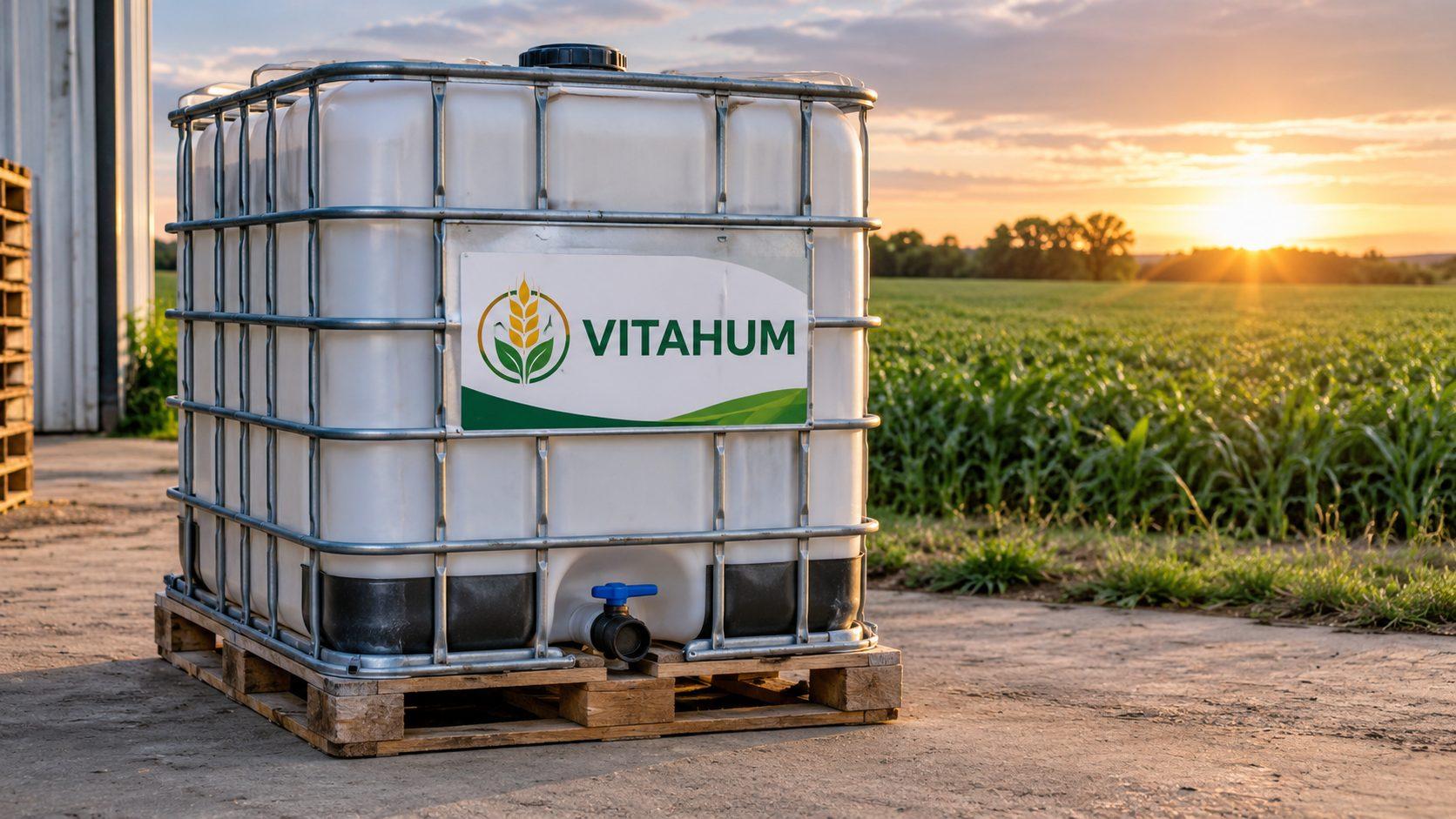
It is the same product sold on the German market as Vitagumin, with no difference in formulation. In Bulgaria it is supplied in 1,000-litre IBCs to farms, cooperatives and agricultural input dealers.
How it works
What it does in the soil
Humic substances are part of soil organic matter, and organic matter drives four things every grower can see in the field.
Structure
Organic matter binds soil particles into stable aggregates. The soil works more easily and crusts less.
Water
A well-structured soil takes in rainfall instead of shedding it, and holds more plant-available moisture.
Nutrition
Humic substances take part in nutrient exchange and keep nutrients within the root zone.
Roots
In loose, aerated, moist soil the root system explores a larger volume.
Key advantages
Why farms choose a liquid humic product
Practical reasons you can check in the paperwork rather than in the advertising.
Low stated rate
The stated working rate is 1 litre per decare (10 l/ha). At that rate one 1,000-litre IBC covers about 1,000 decares, or 100 hectares.
Liquid form
Publicly stated water solubility is about 98% – it is metered as a liquid, with no powders to dissolve.
One raw material: peat
According to the public information for Vitagumin, lowland peat is the only raw material, with no added mineral nutrients.
Documentation on request
Technical specification, certificate of analysis and safety data sheet are provided before any deal.
Individual quote
Price, transport and terms are agreed according to quantity and delivery location – there is no one-size price list.
Sample and meeting
You can ask for a sample or arrange a meeting before committing to a larger volume.
Applications
Use across crops
Cereals, oilseeds, perennial and protected crops each ask something different of the soil. See what is typical for yours.
- WheatMoisture for emergence and nitrogen efficiency.
- BarleyShallower roots, sensitive to acid and waterlogged soils.
- Oilseed rapeSmall seed, dry seedbeds and a taproot that hates compaction.
- SunflowerDeep roots, summer drought and herbicide carry-over.
- MaizePeak water demand in the hottest weeks.
- Vegetable cropsIntensive tillage, frequent irrigation, tired soil.
- OrchardsA soil you cannot swap for twenty years.
- VineyardsSlopes, lean soils and the balance between vigour and quality.
- Greenhouse productionClosed volume, salt build-up, year-round pressure.
Field trials
The numbers come from the field
The figures for yield, mineral fertiliser and irrigation are stated on the basis of field trials carried out with the product. We are working towards publishing them with full data – crop, region, year, soil type, control and treated area.
Until then, you can request the available results from us directly.


Delivery
IBC supply for professional farms
VITAHUM is supplied in 1,000-litre IBCs. Delivery is arranged according to quantity and farm location, and availability and lead time are confirmed with the quote.
- 1,000-litre IBC
- Individual quote for price and transport
- Availability and lead time confirmed before you order
Frequently asked questions
What is VITAHUM?
A liquid product based on humic substances, made from lowland peat for professional agriculture. Composition details are on the Product page.
Are VITAHUM and Vitagumin the same product?
Yes. VITAHUM is the Bulgarian market name of the product sold in Germany as Vitagumin. The formulation is identical.
What is the working rate?
The stated working rate is 1 litre per decare, which is 10 litres per hectare. Actual use follows the technical documentation, the crop and the application method.
Does VITAHUM replace mineral fertiliser?
No. It does not replace mineral fertilisation. The stated effect is more efficient mineral nutrition, under which fertiliser use may fall by around 30–40%, depending on soil, crop and conditions.
Are the trial results guaranteed?
No. The ranges of 20–50% for yield and 30–40% for fertiliser and irrigation were reported in field trials. The outcome on a given field depends on soil, crop, weather and management.
How is it packaged and what does it cost?
In 1,000-litre IBCs. Price, transport and payment terms are given in an individual quote – send an enquiry.
Can I get a sample and technical documentation?
Yes. A sample, technical specification, certificate of analysis and safety data sheet are available on request. See Technical information.
Request a quote for your farm
Tell us your crops, area and approximate volume. You will receive an individual quote with price, transport and lead time – or answers to your questions before you decide.
- +359 887 484 5860887 484 586
- vitahum@outlook.com
Import and distribution of VITAHUM for Bulgaria