The product
VITAHUM – a liquid product based on humic substances
What it contains, where it comes from and what the publicly stated composition data say.
What a humic product is
Humic products are concentrates of humic substances – the dark organic compounds formed as plant residues decay and transform over long periods. In nature they accumulate in soil humus, in peat and in certain coals.
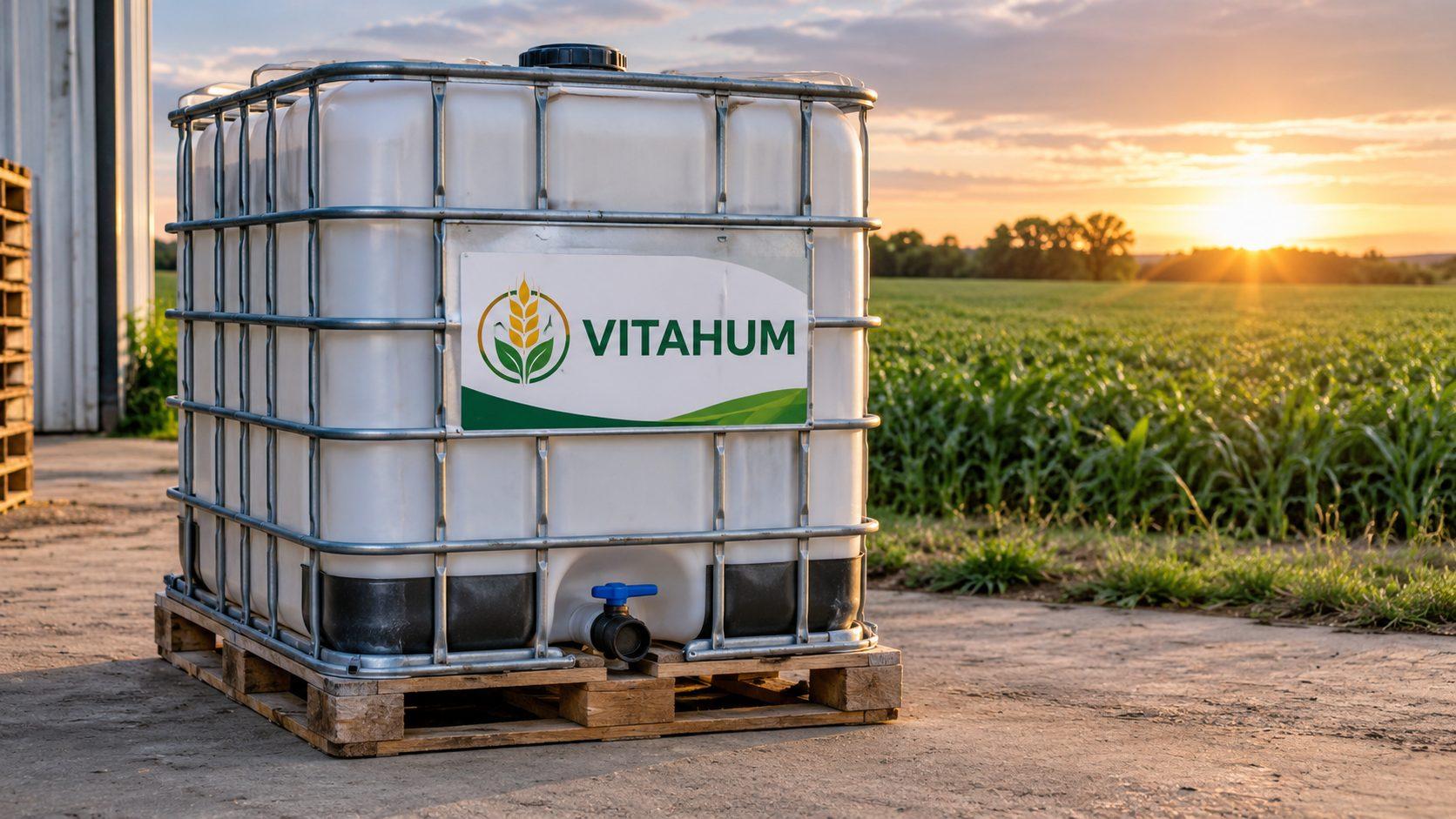
VITAHUM is a dark brown liquid concentrate made from lowland peat. The same product is sold on the German market as Vitagumin; VITAHUM is its name in Bulgaria.
Products of this kind are often marketed as “humic fertilisers”. Regulatory classification, however, depends on the country and on the product's own documents, so we describe it as what it is: a liquid product based on humic substances.
Naturally occurring constituents
According to the public information for Vitagumin, the product contains four naturally formed groups of substances.
Humic acids
The fraction soluble under alkaline conditions. It binds to clay minerals and takes part in aggregate formation and nutrient retention.
Fulvic acids
Smaller, more mobile molecules that stay soluble at any pH and form complexes with micronutrients such as iron, zinc and manganese.
Hymatomelanic acids
The part of humic acids that dissolves in ethanol, listed as a separate constituent in the public product data.
Peat-derived organic matter
Publicly stated organic matter content is at least 76.5% of dry matter.
Origin: lowland peat
Lowland (fen) peat forms in groundwater-fed depressions, where plant residues build up and transform without air over thousands of years. Peat-derived humic substances are geologically younger than those extracted from leonardite.
According to the public information for Vitagumin, peat is the only raw material: no animal-derived inputs, no added mineral nutrients and no formulation additives. Trace elements such as manganese, zinc, copper, cobalt, molybdenum and boron are listed as naturally present.
| Parameter | Value |
|---|---|
| Form and colour | Liquid, dark brown |
| Raw material | Lowland (fen) peat |
| Solubility in water | approx. 98% |
| pH | 9–12 |
| Parameter | Value |
|---|---|
| Organic matter | at least 76.5% |
| Nitrogen (N) | 2.5% |
| Phosphorus (P) | 1.5% |
| Potassium (K) | 2.5% |
| Calcium (Ca) | 1.4% |
| Iron (Fe) | above 1.3% |
| Magnesium (Mg) | 0.7% |
Every percentage in this table refers to dry matter – not to a litre or to the total mass of the liquid product.
Source: publicly stated data for Vitagumin (vitagumin.eu). Final parameters for a given delivery are confirmed by the current technical specification and certificate of analysis. As a natural peat-derived product, composition may vary between batches.
Form, solubility and pH
A liquid with roughly 98% solubility in water is metered and mixed like any other liquid input. The stated pH of 9 to 12 is alkaline, which is normal for humic concentrates because humic acids are soluble precisely under alkaline conditions.
That alkalinity matters for tank mixes and fertigation. Compatibility should never be assumed – check the technical documentation and run a small jar test first.
Application methods
The public information for Vitagumin describes four methods: soil application, foliar spraying with calibrated equipment, fertigation through irrigation systems where technically suitable, and seed treatment where permitted.
The stated working rate is 1 litre per decare (10 l/ha). Rates, tank-mix compatibility and permitted uses are set by the documentation for each country, which is why we do not publish crop programmes before they are confirmed. See applications by crop.
- higher yields
- 20–50%
- less mineral fertiliser
- 30–40%
- lower irrigation demand
- 30–40%
- stated working rate
- 1 l/decare
These figures are stated on the basis of field trials carried out with the product. Actual results depend on soil, crop, weather and farming practice, and are not a guarantee of any specific outcome. VITAHUM does not replace mineral fertilisation and is not a plant protection product.
Technical documentation
The data on this page are publicly stated values, given for orientation. For any delivery, the current technical specification and the batch certificate of analysis apply.
You can request them, together with the safety data sheet, on the Technical information page.
Let's talk about your farm
Send an enquiry for a quote, a sample or a meeting – or call for a consultation. Quotes are individual and without obligation.