
How it works
How humic substances work in the soil
Organic matter is a small share of the soil, yet structure, water and nutrition all depend on it. Here is what is known – and where the established science stops.
What humic substances are
Humic substances are complex mixtures of organic compounds that form in soils, sediments and natural waters as plant and microbial remains decay and transform. They give the humus horizon its dark colour.
Their classic division is operational rather than structural: by solubility at different pH they are separated into humic acids, fulvic acids and humin. Soil scientists still debate how far these fractions exist in that form in the soil itself. What is not in dispute is that the organic matter they are extracted from is central to fertility.
Humic acids and fulvic acids: the difference
The three fractions differ in solubility, and that drives how they behave in soil.
Humic acids
Soluble in alkali, precipitating under strongly acid conditions. Larger molecules that stay put, bind to clay and help form aggregates.
Fulvic acids
Soluble at any pH. Smaller and more mobile, with more acidic groups; they form soluble complexes with micronutrients.
Humin
The insoluble fraction, tightly bound to the mineral part of the soil. Absent from liquid concentrates but part of soil humus.
The role of organic matter
In arable soils organic matter is usually a few per cent by mass, but its influence is out of proportion. It feeds and houses soil organisms, stores nitrogen, phosphorus and sulphur, and glues soil particles together.
Intensive tillage, residue removal and erosion wear it down. The European Environment Agency estimates that more than 60% of European soils show signs of degradation. The symptoms are familiar: capping after rain, compaction, faster drying and a weaker response to fertiliser.
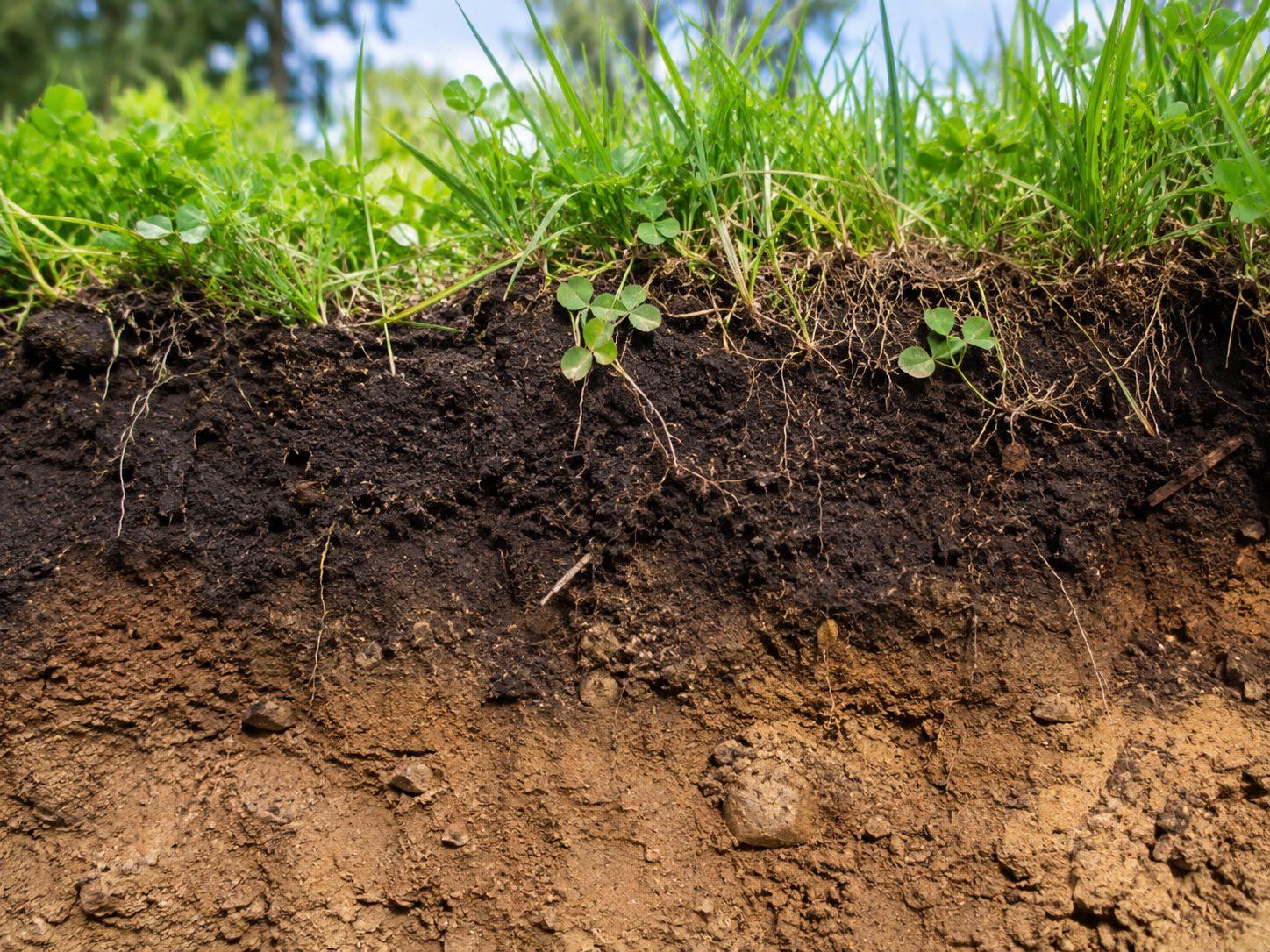
From organic matter to the root
A simplified scheme of relationships known from soil science. It is not a measurement of any particular product's effect.
Organic matter
Humic substances bind to clay minerals and to calcium in the soil.
Aggregates and pores
Water-stable aggregates form, with pores of different sizes between them.
Water and air
Large pores let water and air through; fine pores hold moisture for plants.
Nutrition and roots
Nutrients stay available and roots grow without resistance.
Soil structure and water retention
Soil holds water in its pores. When aggregates collapse the pores seal: rain runs off the surface, and whatever does soak in evaporates quickly through the cracked crust.
A well-structured soil takes in more of the rainfall and releases it to plants gradually. How much extra plant-available water comes with more organic matter depends heavily on texture – more in sandy soils, less in heavy clays. That is why the stated 30–40% reduction in irrigation demand is a result that depends on conditions.
More on this in Organic matter and water retention.
Soil and nutrients
Humic substances carry many negatively charged groups. They hold cations such as potassium, calcium, magnesium and ammonium without locking them away – the plant can exchange for them. This property is measured as cation exchange capacity, and organic matter supplies a large part of it.
With micronutrients – iron, zinc, manganese, copper – humic and especially fulvic acids form complexes that keep them from precipitating at high pH. The same mechanism lets humic substances bind heavy metals and reduce their mobility.
This is the basis of the stated gain in mineral nutrition efficiency: fewer losses from applied fertiliser, not a substitute for fertilising.
The soil environment and root development
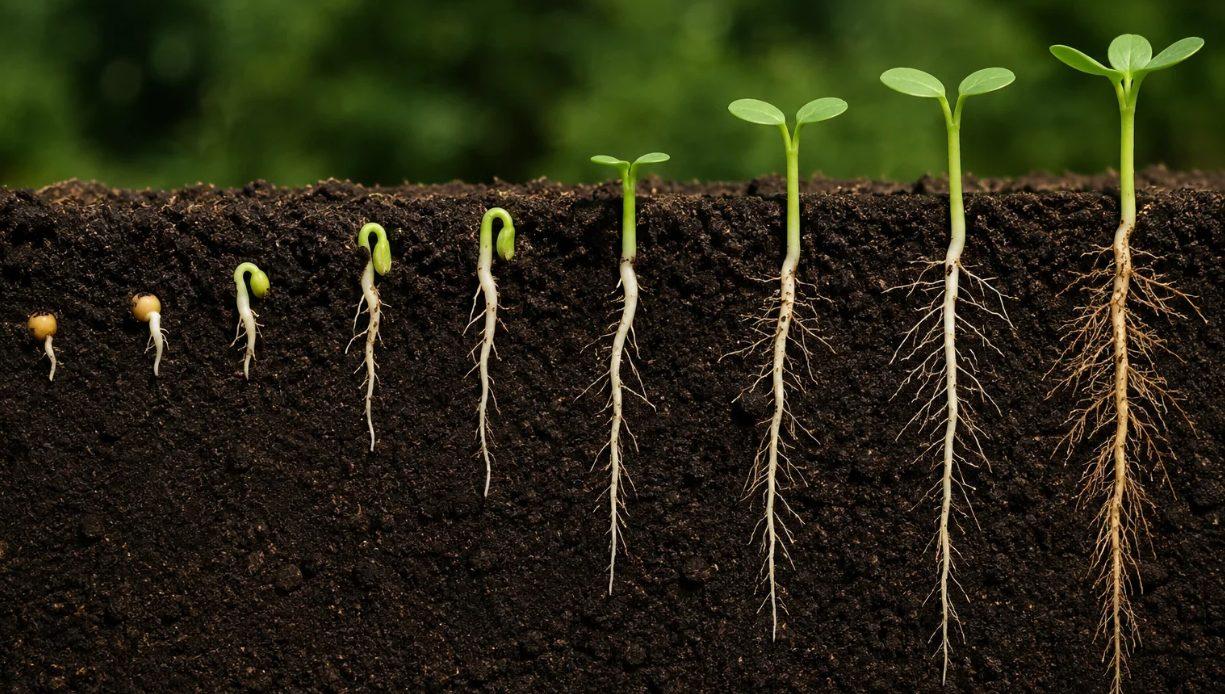
Roots grow where there is air, moisture and little mechanical resistance. In compacted soil they stay shallow and branch near the surface – and the crop suffers in the first dry spell.
The scientific literature also describes direct effects of humic substances on root growth, observed in laboratory and pot experiments. How far these carry over to the field depends on product, rate, soil and crop, which is why field trials – not general statements – must carry the weight of proof.
Sources
Let's talk about your farm
Send an enquiry for a quote, a sample or a meeting – or call for a consultation. Quotes are individual and without obligation.